


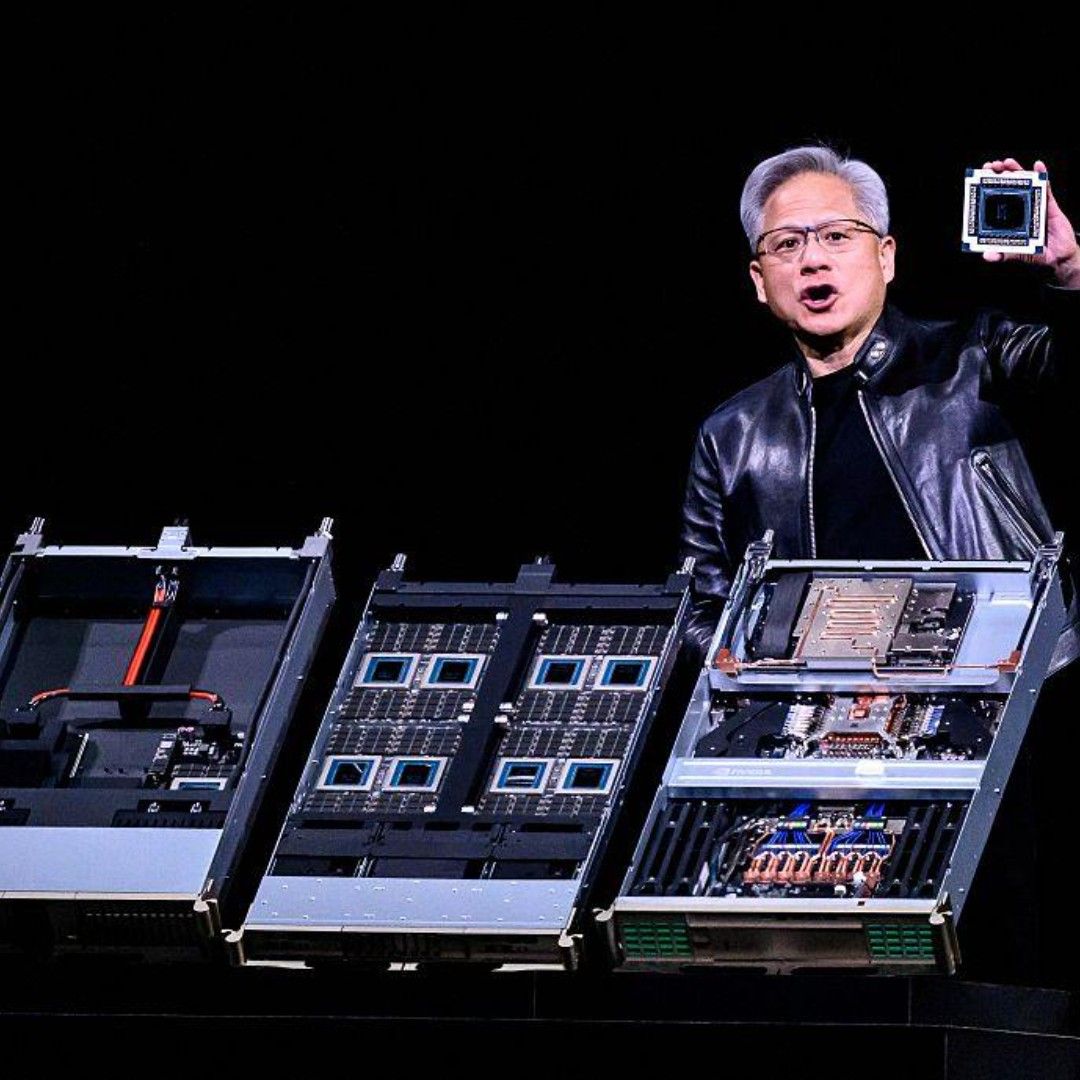
Originally published by WorldsEdge Media · By Jensen Huang presenting Nvidia's Vera Rubin AI computing platform at GTC 2026.. Read it on WorldsEdge Media
WorldsEdge Media | Billions | News Analysis | November 24, 2026
On Nov. 17, Nvidia reported quarterly revenue of $115.8 billion under interim CEO Colette Kress. Its data center business had grown 110% from the previous year. The company had begun shipping its next generation of AI computing systems and continued to expand its commercial partnerships. Yet investors were selling. [1]
Six days later, Jensen Huang was back at the helm of Nvidia, and the company's shares had appreciated by 31.48% in a single trading session. [2]
What happened between those two dates warrants a closer examination of how much of America's financial prosperity has become dependent on the artificial intelligence industry.
On Nov. 11, Nvidia's board of directors accepted Huang's resignation as president, CEO and board member. Kress, who has served as the company's chief financial officer since 2013, assumed executive leadership while the board initiated a search for his successor. [3]
The circumstances surrounding Huang's departure introduced concerns about national security and corporate governance. An independent investigation remains underway.
During the ensuing trading sessions, Nvidia's share price declined from $173.73 on Nov. 11 to $125.53 on Nov. 20, a loss of approximately 27.7%. The company's earnings announcement, despite demonstrating substantial commercial growth, failed to reverse the decline. [2]
There was considerable wealth at stake in the board's decision to bring Huang back.
America's financial exposure to artificial intelligence
The capital circulating through the AI industry extends well beyond semiconductor manufacturing. Financial institutions are underwriting infrastructure projects, technology companies are committing billions to computing capacity and energy providers are preparing for increased electricity consumption.
Nvidia's November earnings report identified Google Cloud, Microsoft Azure, Oracle Cloud Infrastructure and CoreWeave among the companies deploying its latest computing systems. Their ability to accommodate the growing demand for AI services depends, in part, on Nvidia's production and technological advancement. [1]
Consider the individual whose retirement savings are invested in an S&P 500 index fund. That person has financial exposure to Nvidia regardless of whether they understand artificial intelligence or have ever purchased shares in the company directly.
As technology companies acquire greater weight within market capitalization-weighted indexes, their performance becomes increasingly consequential to the financial security of ordinary households.
Huang's brief absence also gave shareholders a glimpse of Nvidia under different stewardship. The company remained profitable, but the prevailing confidence in its future appeared more precarious than its financial statements would suggest.
The government's interest in Huang
In its Nov. 23 announcement, Nvidia disclosed that its board had received input from senior levels of the U.S. government before unanimously deciding to reinstate Huang the previous day.
“We have every confidence in Jensen and look forward to working with him as he resumes his leadership of the Company,” said Harvey C. Jones, chair of Nvidia's board. [4]
House Speaker-designate Hakeem Jeffries challenged the decision and called for stronger semiconductor export restrictions through the National Defense Authorization Act. He also pledged to pursue a congressional investigation into Nvidia and the Department of Commerce. [5]
For Washington, the proliferation of advanced semiconductor technology presents a dilemma. American companies have a commercial interest in expanding internationally, while the government considers access to certain technologies a matter of national security.
The economic consequences of restricting that access, or disrupting the leadership of a company as influential as Nvidia, cannot easily be contained within the technology sector.
Following the 2008 financial crisis, the expression too big to fail became associated with institutions whose collapse could destabilize the financial system. Nearly two decades later, artificial intelligence presents a different set of circumstances.
Nvidia was never facing insolvency during Huang's absence. Its engineers continued developing technology and its customers continued purchasing it.
His reinstatement nevertheless warrants scrutiny of the government's involvement and the precedent it could establish for other technology companies.
As America continues investing in artificial intelligence to secure its economic future, how much discretion will corporate leaders be afforded when the financial consequences of holding them accountable become too costly?
WORLDSEDGE MEDIA
BILLIONS | DATA JOURNALISM
Nvidia Without Jensen Huang
November 11–23, 2026
−27.7%Share price decline
Nov. 11–20
Reinstatement rally
Nov. 23
Daily closing share prices (USD)
Nov. 11 | $173.73Jensen Huang resigns. Colette Kress is appointed interim CEO.
Nov. 12 | $166.19Shares decline 4.34% from the previous close.
Nov. 13 | $162.85Nvidia finishes the trading week under interim leadership.
Nov. 16 | $156.14Shares continue to decline ahead of quarterly earnings.
Nov. 17 | $155.46Nvidia reports $115.8 billion in quarterly revenue and $107.6 billion in data center revenue.
Read financial results Nov. 18 | $150.96Shares close lower following the earnings announcement.
Nov. 19 | $145.98Selling continues as Nvidia closes below $146.
Nov. 20 | $125.53Nvidia reaches its lowest closing price during the period, approximately 27.7% below its Nov. 11 closing price.
Nov. 23 | $165.05Nvidia announces Huang's reinstatement. Shares appreciate 31.48% from Friday's close.
Read the official announcementSelect each date to explore the corresponding market data and developments.
Sources: Morningstar, SEC filings and Nvidia Investor Relations. Bars represent closing prices on a $0–$180 scale. Market movements alone do not establish causation.
WORLDSEDGE.WORLD | ORIGINAL DATA JOURNALISM
Source attribution
The following references correspond to the numbered passages in the article.
Ref.
Source and verified information
[1]
Nvidia Investor Relations — Quarterly earnings, data center revenue and commercial partnerships.
[2]
Morningstar Historical Trading Data — Closing share prices. Percentage changes independently calculated.
[3]
SEC Form 8-K — Nov. 11 — Huang's resignation and Kress' appointment.
[4]
SEC Form 8-K — Nov. 22 and Nvidia's reinstatement announcement — Board decision, government involvement and direct quotation.
[5]
Hakeem Jeffries — Official Congressional Statement — Congressional response and proposed export restrictio
